Self-driving cars have been just around the corner for more than a decade, but the timelines kept slipping. Nonetheless, there are now places where autonomous vehicles really do exist and where self-driving can be experienced firsthand. In the United States, almost all Tesla owners can use Full Self-Driving (Supervised) (FSD). In selected cities, passengers can also ride in robotaxis from Waymo and Tesla. But how good is the technology really? Is self-driving finally around the corner, or is it still a decade away?
When my wife and I planned a two-week vacation in California, the opportunity was too good to miss. I rented a recent Model Y with FSD (version 14.3.6) through Turo, and we also took two Waymo rides in San Francisco. This post summarizes my personal impressions after roughly 1,600 miles of city traffic, freeways, mountain roads, nighttime driving, construction zones, and even a dirt road.
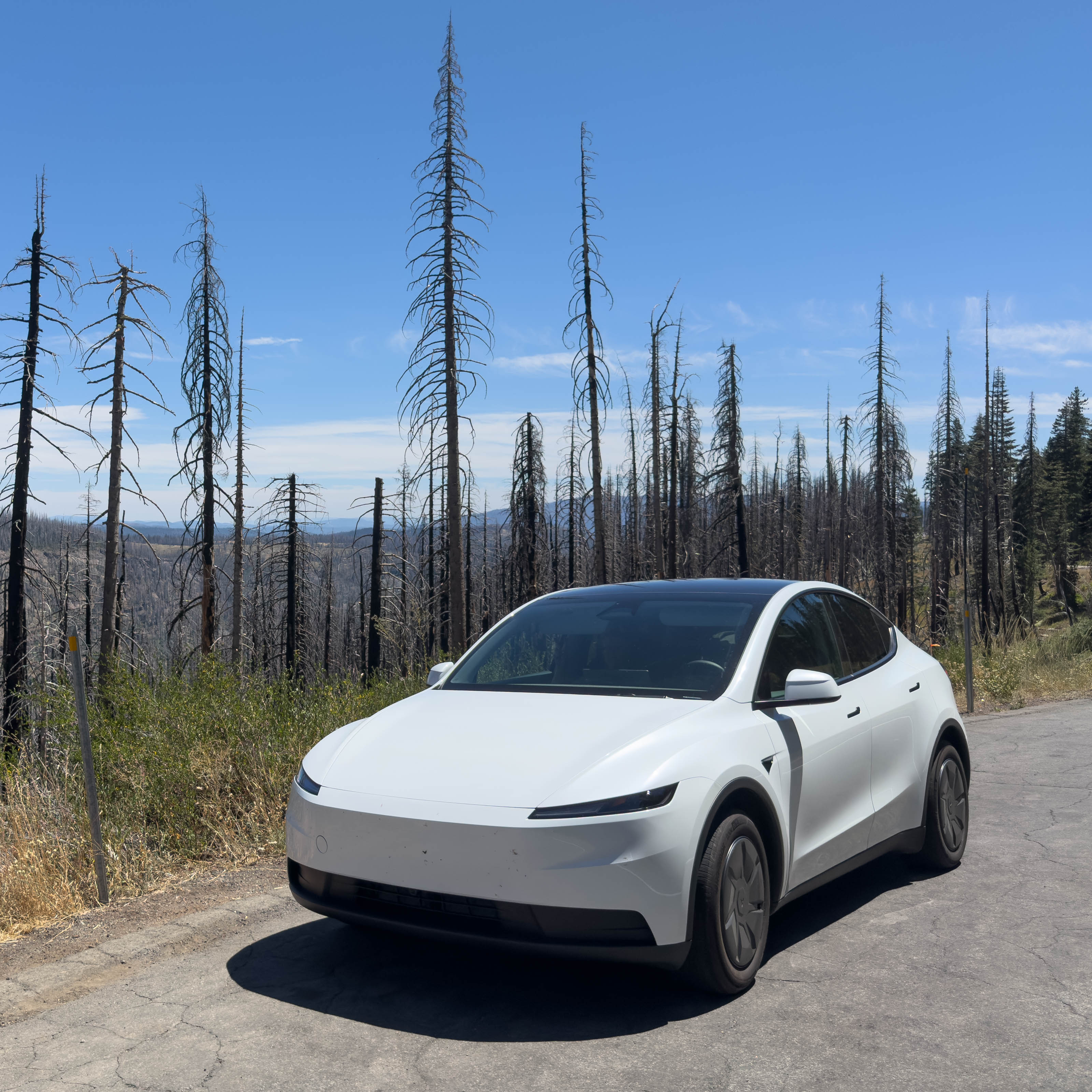
Long story short
Long story short: I did not have a single safety-critical intervention. After the trip, I am convinced that the essential driving task is largely solved. FSD drove remarkably well, and I believe it made fewer mistakes than I would have made myself.
Nonetheless, I did take over, but only to park the car, adjust the route, avoid an uncomfortable pothole, or simply pull over for a photograph in a national park. FSD did almost all of the driving, but that does not mean the autonomous car is solved.
Once the car can drive, the goalposts move: Can it park where I want? Can it question an unhelpful route? Does it understand why I want to slow down or pull over? Essentially, can it behave like a chauffeur? Just as ChatGPT creates a complete product experience around the GPT model with chat, web search, memory, and more, an autonomous car product is more than an AI model that can drive a car.
That distinction only became clear to me during the trip. So let me take you along for the ride, starting with my first few minutes with FSD at San Francisco International Airport.
Meeting FSD at San Francisco International Airport
After picking up the Model Y in a parking garage at San Francisco International Airport, I enabled FSD immediately. I was excited, but also a little overwhelmed by driving at an unfamiliar airport, checking whether the route on the screen matched the signs around me, and monitoring FSD at the same time.
The car drove out of the parking garage and through the busy arrivals area. In the standard driving profile, it felt a little too sporty for my taste and my state of mind at that moment, so I took over.
An intervention after only a few hundred meters was a rough start. In retrospect, however, I disengaged mainly because I did not trust the car yet and did not know the FSD product well enough. Switching to Sloth mode, the slowest speed profile, would have made the car drive more to my taste. Still, I would prefer FSD to behave more defensively in an arrivals area in future releases, regardless of the speed profile.
Driving to the Golden Gate Bridge
Once we had cleared the arrivals area, I engaged FSD again. The car confidently joined US 101 and continued via I-380 and I-280 toward the Golden Gate Bridge and the Battery Spencer viewpoint.
My confidence grew with every mile as the car cruised the freeways, handled city traffic, and navigated the small, winding roads in the Marin Headlands. Every clean lane change, nicely executed turn, and well-judged merge helped. At one point, the car left generous space for a cyclist. Very quickly, I started to feel like a passenger in the driver’s seat.
By the end of that first day, despite the initial hiccup, my expectation had largely been confirmed: FSD was extremely good at driving. But parking was a challenge.
At Battery Spencer, I parked manually because I spotted a good space before we reached the destination pin. At Point Bonita Lighthouse, FSD did not recognize an available parking spot. At our final destination, it tried to park in the wrong driveway. This pattern continued throughout the trip: Driving the miles was easy for FSD, while completing the final few meters was not.
Parking is harder than driving
Why is parking so hard? The main problem is not necessarily controlling the vehicle. It is knowing what the person inside the vehicle actually wants.
To reach a destination, FSD typically begins with a point on the map. Once it gets there, it has to infer the rest. At Battery Spencer, I had seen a convenient space before the destination pin and decided to take it. At our final stop, the map coordinate apparently did not explain which driveway belonged to the address. In the current version, FSD did not appear to connect the visible house numbers (which it can most certainly see) with the destination address in the navigation system well enough to make the right choice.
To put it another way: A GPS coordinate or address communicates where I want to go. It does not always communicate what I want the car to do when we get there.
Over the next few days in the San Francisco Bay Area, the first impressions held up: The road driving was flawless, while parking worked only about half the time. But how would FSD behave outside the city? Our first longer trip took us north to Lassen Volcanic National Park.
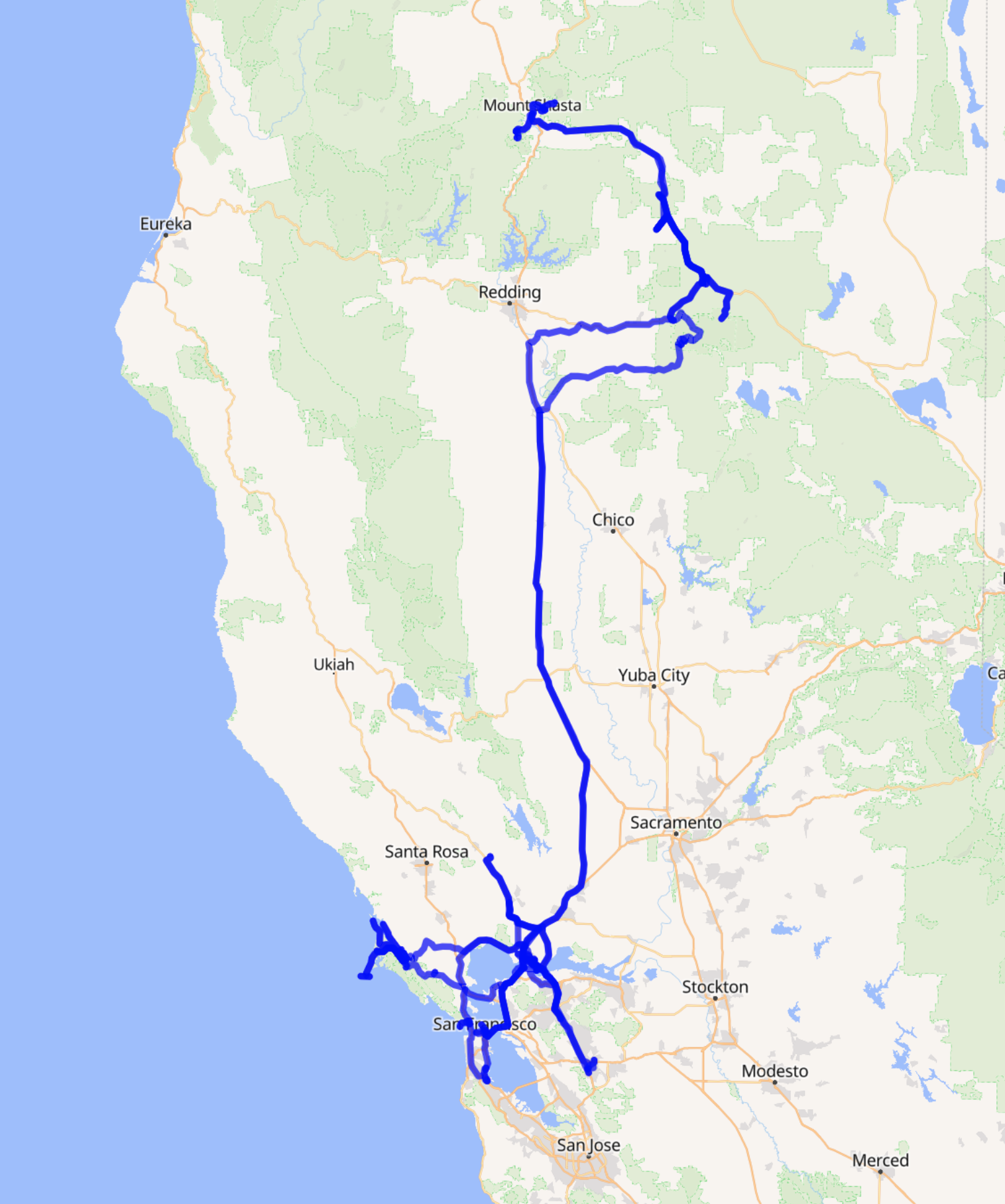
(Map created with gpx.studio from the GPS track I recorded during the trip.)
Lassen Volcanic National Park: The road is the destination
The route north included Bay Area freeways, I-5, smaller country roads, winding mountain roads, and finally the roads inside the park. FSD handled all of it.
Driving in a national park is different from driving in a city, however, because the road is frequently part of the destination. Even in the slowest driving profile, Sloth mode, FSD sometimes felt too fast for sightseeing. Driving at exactly the speed limit is not always the point of a scenic drive, especially when nobody is behind you. I wanted more time to enjoy the landscape, look for wildlife, and notice possible viewpoints. At one point, I drove manually for one or two kilometers because I preferred a slower pace.
Don’t get me wrong: FSD was transporting us perfectly well. It just did not know that transportation was not our current objective.
This is where I first wanted to talk to the car as I would talk to a chauffeur: “Slow down a little. We’re sightseeing.” A driving profile can encode how the car should drive in general. It cannot express why we are driving this road today.
Tesla is apparently already working on a voice interface between Grok and FSD:
Working on it.
Ashok Elluswamy on X
An unpaved road to the Cinder Cone
The road toward the Cinder Cone trailhead was a good-quality dirt road, a scenario far removed from the typical city or freeway FSD driving. Nonetheless, the car handled it confidently. However, I took over twice to avoid potholes.
These interventions were not safety-critical, but they were certainly relevant to comfort, and I did not want the car to suffer unnecessarily. FSD understood that the road was drivable, but it did not seem to look for a comfortable line. Instead, the car treated the dirt road like a paved road without markings.
Driving safely and comfortably on a dirt road is quite a different skill from driving on city streets. With Tesla currently prioritizing getting robotaxis on the road, I suspect this kind of optimization is just not high on their agenda.
Mount Shasta: Should the car trust the map or reality?
One day, we drove as far up Mount Shasta as the road allowed. By then, it had become repetitive to say that FSD handled the actual driving confidently, but that is how it was. The mountain road, however, revealed a different rough edge: Should FSD trust the map or the road in front of it?
The general speed limit was 55 mph, but at times FSD switched to 25 mph even though I had not seen a corresponding speed-limit sign. Perhaps I missed one. Perhaps a sign used to be there. Or perhaps the map data was wrong.
I observed the opposite error while entering the town of Mount Shasta: A visible speed-limit sign was not recognized. In one case, prior information seemed to override the road. In the other, the road did not seem to update the prior information.
The underlying mechanics are hard to guess. My suspicion is that this behavior may be leftover logic from the Autopilot days, when the system could be trusted far less to make the right decisions and map data therefore had more authority. In the long run, I would hope that FSD treats map information as a valuable prior (a trustworthy source that still needs to be checked constantly against reality), rather than as ground truth it must strictly follow.
The longest streak
On the return trip through Lassen toward the Bay Area, the car managed its longest continuous FSD streak: A little more than 250 kilometers, interrupted by (guess what?) parking.
The parking deficiency had become a running gag, but the most comical incident happened at a Supercharger in Red Bluff. Almost every stall was occupied, and the car selected the wheelchair-accessible charging stall. It then failed to align itself properly, ending up much too far to the left within the charging stall. Parking at a Supercharger should be about as mainstream as a Tesla task can get, but apparently wheelchair-accessible charging stalls are still an edge case.
Without parking interventions, a 500-mile streak would easily have been possible. To push the gamification further, I found myself wishing for an “intentional takeover” button: Let me take control for a photograph or a specific parking maneuver that I expect to fail without ending the fault-free streak. Yet Tesla may have deliberately chosen not to provide such a button so that it can collect more training data from difficult situations. After all, parking disengagements followed by the correct human maneuver could become training examples for future FSD versions.
Here is how the car celebrated the streak:
Two Waymo rides: What changes when I become a passenger?
Back in the Bay Area, my wife and I took two Waymo rides in San Francisco. One took us from Chinatown toward the Palace of Fine Arts area. The other brought us back toward Coit Tower.
Hailing a Waymo was as simple as hailing an Uber: Download the app, add a payment method, enter a destination, and wait a few minutes. The experience was quite different from FSD. Most importantly, there was no driver. We sat in the back of the Jaguar I-PACE, and the product was designed around us as passengers. The car greeted us, let us connect Spotify, and reminded us not to forget anything when we got out.
The actual driving was good, although it felt slightly less smooth than Tesla FSD to me. Waymo sometimes made small left-right steering corrections while driving straight, and a few stops felt less polished.
In one situation, our Waymo wanted to turn right while another vehicle approached on the road it was entering. It abandoned the turn, continued straight, and routed around the block. Everything remained safe, but a more defensive approach would have been to slow down earlier, wait for the traffic, and then complete the original turn. If that situation had been part of a practical German driving test, I am quite sure the vehicle would have failed.
Waymo’s big advantage was the final few meters. Across the two rides, it completed two pickups and two drop-offs without any drama: Four out of four. Well done!
To put this difference in parking performance into perspective, stopping for a passenger to board or exit the car is, from my point of view, much easier than consistently finding a good parking spot and executing the full maneuver. Nonetheless, kudos to Waymo.
Of course, two rides are nowhere near enough for a complete picture. Nonetheless, my subjective impression was that Tesla FSD was the better driver because it was smoother and we had seen it work across a much broader range of roads. Waymo scored with a complete robotaxi product (something Tesla FSD (Supervised) intentionally is not at this stage) and flawless pickup and drop-off handling.
I would also have liked to try Tesla’s Robotaxi service, but its app was not yet available in the German App Store. This is therefore a snapshot, not a verdict. Both products are moving targets.
To give you a hands-on comparison of Waymo and FSD, here are two short clips I recorded:
The drive out of San Francisco: Beating human fatigue
After a long day in San Francisco and an Alcatraz night tour, we started the return trip at around 10 p.m. The drive out of the city took more than an hour. It included nighttime traffic, unfamiliar streets, freeways with six or seven lanes, a closed exit, and rerouting.
FSD handled the drive extremely well. I intervened once because I wanted to make sure it would find a meaningful route after the closed exit blocked the initial route. As it turned out, I should simply have kept FSD engaged. It felt as if we could have slept through the whole drive and the car would still have brought us home safely and comfortably. Even though FSD still needs to be supervised (and the driver-monitoring system notifies you if you do not pay attention), it really feels as if it is fit for unsupervised operation.
After this long day, FSD turned a journey that would otherwise have been stressful for me into a relaxing end to the day. It was not only a demonstration that FSD also worked well at night. It demonstrated an advantage that no human driver can match indefinitely: FSD does not get tired. The relevant benchmark was not a hypothetical perfect human driver. It was me, at 10 p.m., after a long day and an Alcatraz night tour.
Point Reyes: Who decides the route?
Our final three-day excursion took us to Point Reyes National Seashore. The roads were narrow, winding, rural, and very scenic. FSD handled them beautifully. It was a joy not only to watch the landscape, but also to watch the car take every bend.
After two weeks, I had a good sense of what FSD could do and where it might struggle. Ordinary self-driving had become a commodity. That lack of drama was itself a result: Competence had become the default.
What remained interesting was detailed navigation. At the Cypress Tree Tunnel, I had parked manually on the side of the road, facing west. After our visit, we wanted to return to Inverness. Instead of turning around, navigation wanted us to continue west for four or five miles before reaching a mapped place to turn.
Similar to the speed limit on the Mount Shasta road, it looked as if the route on the navigation system dominated FSD’s own judgment. The obvious action would have been to turn around with a three-point turn (which I did manually) instead of driving a few miles in the wrong direction.
Again, this was not a lack of driving skill. From my point of view, the product wrapper around the driving model was too dominant. FSD knows how to perform a three-point turn. In another instance, it had performed the maneuver in a dead end. This was also quite an edge case because the next “official” opportunity to turn around was so far away. On a city street, where the car can simply drive around the block, the problem might never surface, and going around the block might even be the better choice.
Looking back: How to classify an intervention?
The long tail of autonomous driving is very long, and I found it interesting to see how frequently edge cases appeared. The car solved most of them beautifully, but a few remained. Looking back, however, simply counting interventions is not a useful metric. This is how I would classify them:
| Category | What it means | Example from the trip |
|---|---|---|
| Safety-critical | I needed to prevent an unsafe outcome | None |
| Parking | The car did not complete the destination maneuver I wanted | Parking lots and destination driveways |
| Navigation | The car could drive, but followed an unhelpful route or direction | Cypress Tree Tunnel |
| Comfort | The driving was safe, but not how I wanted to travel | SFO arrivals and scenic roads |
| Road surface | The trajectory was safe, but unnecessarily uncomfortable | Potholes on dirt and mountain roads |
| Intent or manual choice | I wanted something I could not communicate to the car | Photo stops and specific parking choices |
The most important row is the first one: I had zero safety-critical interventions during about 1,600 miles of travel. My rough impression is that parking worked about half the time. The other categories appeared only occasionally and in special conditions.
If I counted every takeover, my estimate would be somewhere around 50. But that number communicates almost nothing about what FSD can do. Taking over because I want a photograph and taking over to prevent a collision both increment the counter by one. They are not the same result.
The trip exposed two layers:
- The core FSD driving system handled the road extremely well and reliably.
- The interface between the person and the car was still little more than a destination, a driving profile, and a “Start Self-Driving” button.
The second layer was where essentially all of my interventions came from.
The missing layer: From a driving model to a chauffeur
Let’s break down a classical taxi ride with a human driver:
- You get into the car.
- You tell the driver where you want to go.
- The driver gets you from A to B.
- As you approach, you explain where exactly you want to be dropped off.
Current self-driving products handle steps two and three. Waymo also showed how well the basic version of step four can work. The messy part is communicating all the nuance that a human driver understands naturally.
Imagine driving to a restaurant in a small town. Let’s assume there is no parking space in front of it, so FSD continues down the street looking for the next one. You might want to say, “Turn around and take the space on the other side,” or “Let’s check the side street instead.” Today, there is no good way to communicate that intent to the driving system.
For a robotaxi, the problem is actually easier because the car does not necessarily need to park (it does not need to find a parking spot where it will stay for a while). Instead, it only needs to find a safe place to drop you off and can then continue. That helps explain Waymo’s strength at the final meters: Pickup and drop-off are central to the product, not an extension of the driving demo.
Storing your preferences
I have one particular preference that I also could not communicate to the car: Schattenparking. Whenever possible, I like to leave the car in the shade so that it does not heat up, even if I could start the air conditioning a few minutes before returning. By the way, starting the A/C can be a challenge with patchy mobile service in a national park or even in the Marin Headlands!
At some point, I would like my car to have something like an AGENTS.md or CLAUDE.md, perhaps an FSD.md: Persistent instructions that say, “Try to find a parking space in the shade,” “Prefer an easy exit,” or “At home, use the parking spot next to the garage.” It does not literally need to be a Markdown file, but why not? The point is that the autonomous car should remember what the passenger prefers.
A natural-language interface
The communication should also work in both directions. Imagine entering a large parking lot. How do I know whether FSD has a useful plan? The car could simply tell me, “I’m looking for a parking space in the shade,” or “Let me drop you off in front of the store, then I’ll find a parking space.”
This kind of conversation has appeared in science fiction for decades. To me, it now looks like the final missing piece of the autonomous-car product: A layer around the driving model that turns it into a digital chauffeur.
Tesla has already started moving in this direction. Our Model Y supported “Hey Grok,” and Grok can now issue navigation and other vehicle commands. But its integration into the driving task was still limited. Opening more navigation and vehicle functions to the language model would be similar to giving an AI agent tools: The language model understands the request and then calls the specialized driving system to carry it out.
The driving model and the language model now exist. Connecting them into a reliable product is the remaining challenge.
So, is driving solved?
Just as I do not find it useful to count all interventions equally, I think we have to break this question into three smaller ones:
- Can the car physically drive ordinary roads safely? Based on this trip, my answer is a strong yes.
- Can it drive like an excellent human driver? Most of the time, yes. It still had a few rough edges, but across the full trip, I believe it made fewer accumulated driving mistakes than I would have made driving manually.
- Can it behave like an excellent human chauffeur? Not yet. That requires understanding the passenger’s intent, making higher-level judgments, and handling the complete journey rather than only the road.
So, is self-driving around the corner? My intuition is yes (pending regulatory approval). I can now see the building blocks: The FSD driving system, language models for conversation, and the tool layer that connects the two.
Waymo is already an existence proof that autonomous passenger transport works inside a supported service area. Tesla gave me a different kind of existence proof: A normal production car could drive through an extraordinary range of roads and simply continue driving.
Back in Germany
On the way home, we took a taxi from the train station. I caught myself thinking: “What is this guy doing in the driver’s seat? Why is he there?” Of course, the obvious answer was: To drive the car. Yet he chose a suboptimal route, and the ride felt less smooth than FSD (even though I could talk to him 😉).
Similarly, I miss the “Start Self-Driving” button in my Tesla Model 3. While regulatory approval will apparently still take a while, I will remain not only “the human in the loop” but also fully in control in the driver’s seat 😉.
While autonomous taxi services and autonomous vehicles still need to scale and overcome a lot of regulatory hurdles, this vacation convinced me that self-driving is around the corner. I experienced the future firsthand: It is already here, it is just not evenly distributed.
Until the future arrives in your geography, here is a simple recipe for experiencing it yourself: Book a trip to the United States, rent a Tesla with FSD, and add a few robotaxi rides.